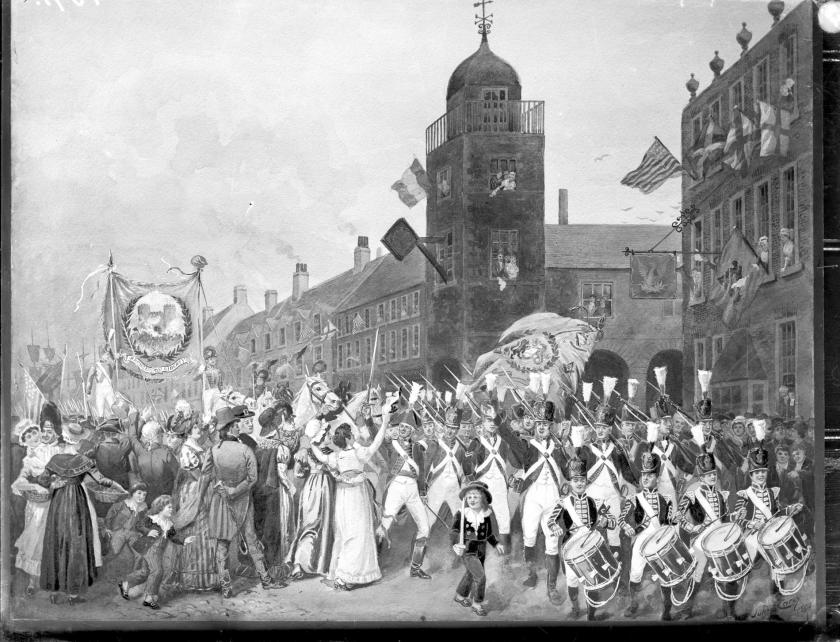
JULY 14 is Bastille Day in France. 230 years ago in Belfast a French Revolution Commemoration was held, with Irish Volunteer Companies from the town and surrounding hinterland paraded out to the Falls Road review field, held a review, then paraded back.
Events marking ‘Bastille Day’ have been taking place again in Belfast in recent years, seeking to ‘reclaim’ this previously massively undervalued heritage.
Back in 1792, it would have been in many ways similar in appearance to a Twelfth, though the egalitarian values of the French Revolution and the values of the Orange Order were off course very different, as a look at the very different banners, in each parade would have soon told you.
There would have more guns, as most were armed, as citizen soldiers. The reviewing officer was Crawford of Crawfordburn. The new United Irishmen societies had been spreading like wildfire through the country since October the previous year. Catholic collective identity was totally suppressed at that time, but a movement for change was forming.
The Catholic Committee, with its HQ in Dublin, sent up some of their top people to attend this commemoration, representing as it did, the political power of Presbyterian/Protestant Belfast. The Church of Ireland slave plantation owner Waddell Cunningham took part. Their presence was a signal to the hopelessly corrupt Irish puppet government, that a potentially formidable new political alliance was being formed.
The most important business of the day was the meeting in the Linenhall where the radicals wanted a motion calling for immediate and complete Catholic Emancipation to be agreed. Wolf Tone steadied the troops in a potato field over the dyke from the review ground. It was carried, but only after the less radical country companies had left the meeting. Many from County Down were rattled by the way huge numbers of Catholics were parading with arms around Hilltown.
In contrast to the simplistic narratives that so commonly circulate about the United Irishmen, the reality was full of nuance, with Irish and British political threads mixed together in a very complex way. Catholics had no power.
Protestants, the majority of whom with origins in Scotland, were starting to politically tussle over which was best, to continue the traditional affiliation with GB, or to throw their lot in with the majority community on the island, who had been brutally conquered. The matter is ongoing today, with the rebound of that suppressed Catholic collective identity, having formed a successful democratic state in the Republic of Ireland.
But intolerant sectarian populism is also on the rise, demonising and blanket tarring their protestant/unionist neighbours with the actions of the few. False conscious theory is often used as the pseudo academic front for intolerance. Political unionism does little to help itself and their constituency, pursuing British or nothing policy goals, showing poor leadership in respect of issues such as bonfire control, the size of some and what goes on them.
Human Rights seems weighted to the mindsets of past power relations between groups, not future ones. The centre ground remains weak, but there are hopeful searchlights probing the gloom too.
 Opinions creatively
Leave a comment