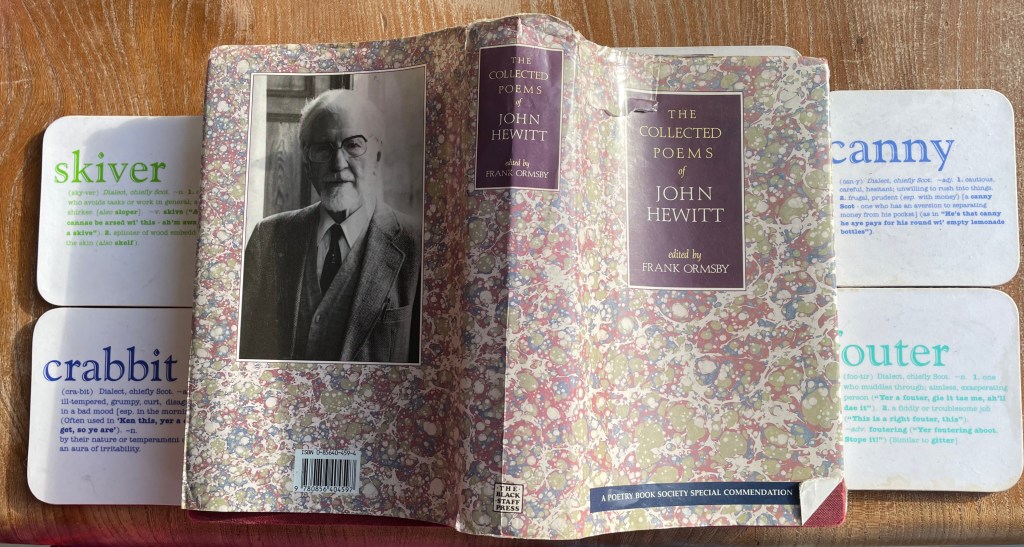
CONTENTS of a letter I wrote to the Belfast Telegraph, responding to an article ‘Why we should be reflecting on use of term ‘planter’ today’ by columnist Malachi O’Doherty in the May 31 paper, written after the recent outcry about US Congressman Richard Neal’s use of the word ‘Planter (and Gael)’.
They probably get a lot of letters and didn’t publish it, so here it is.
Dear Sir
I find myself disappointed with aspects of Malachi O’Doherty’s article on John Hewitt in last Tuesday’s (May 31) paper.
It’s all the more disappointing as Malachi has a fair claim to have contributed to a centre ground trying to reconcile itself, and takes his share of abuse from the wings as a consequence.
Though the summary of the poetic response to Planter/Gael by Hewitt and his peers is interesting, the scabbiness of space he allows Hewitt is striking, showing his irritation at the subject matter of some of Hewitt’s poetry.
He feels that Hewitt was ‘almost obsessed’ with ‘the difference between himself and his Catholic neighbours’ and who ‘laboured so much’ ‘about the tensions between Protestant and Catholics.’
Though he ‘absolves’ Hewitt because of his introspection, his moral ‘anguishing’.
Ordinary Protestants are traditionally stuck between the horribly low status accorded to literature by ‘Parading PUL’ unionism and the ‘abandon ship moral anguish brigade’ of writers/artists from the Protestant/Unionist community rejecting that background.
Periodically you still get people putting their public disowning on record in the Tele, Irish Times etc.
Hewitt stood on the difficult ground between the two and society is the richer for it.
He put into language some of his experience, grasping the nettle, saying the unsaid; saying what had been previously said in a right-wing way, but in a middle ground or more left-wing way, offering an alternate way.
True, some passages are dated, and he comes across as almost Granda-esque at times.
His book Rhyming Weavers, is one of the foundations of the modern literary revival in Ulster-Scots.
The demographic change here caused by the 16th and 17th century migrations, among them the ‘Plantation’ created a self-evidently huge collective footprint moving though time, that is still not politically assimilated into Irish life.
It dominates the history and politics of Ireland to this day.
Malachi doesn’t need me to advise him on the hugeness of this subject.
Yet, in his highly selective piece, he reduces the collective relations between the traditionally ethnoreligious/nationally aligned groupings here to a set of morally dubious fleeting impressions between individuals.
Hewitt’s on the subjects of his poems, Malachi on Hewitt.
The inference of sectarian relations, the sectarianism Hewitt’s not his.
The suggestive hoking out of echoes of the archaic power relations between Catholic and Protestants, once unequal.
Malachi is understandably suspicious about language echoing of such power relations.
More generally, his sketch could, to those inclined, find echoes in Alabama.
The Afro American vision is for civic equality on all levels.
The presumed entitlement to political supremacy of nationalism over unionism on the island, is the constant fellow traveller with civic equality in Irish nationalism.
Common also the irritable ‘get over yourselves and be Irish’ badgering to assimilate.
The risk of being demonized if you fail to do so.
I know Malachi ‘has thoughts of his own’ and didn’t mean it that way.
Given the context created by the terminal hash of Brexit, the moral template he created was evocative nevertheless.
With the Ulster-Scots community now in the process of being designated a national minority, and with the increasing interest in Human Rights, from within the Protestant, Unionist, Loyalist and British communities, one would hope that such explorations as Hewitt immersed himself in, creating narratives (all be it very cautiously) affirming collective existence and so much more, will become easier and less the object of scepticism, suspicion and far worse, under European and international protections.
 Opinions creatively
Leave a comment