WITH major public debate ongoing about a possible united Ireland, sometimes it appears to me that the protestant and unionist community has been left hardly able to open its collective mouth because of constitutional conflict.
This may seem ironic given the number of people from that background on social media slabbering heartily like the rest, including elected leaders doing their evening news rants and disowner prods saying they’re not like the DUP, to name but a few examples.
But in another way, there is a deep seated reticence that has prevailed for as long as I can remember.
North Antrim village lamp posts sport banners of American civil war soldiers and people with ultra tenuous links to areas coming down with heritage – why is that?
How has the struggle over the constitutional question left the community mute in certain ways?
I will try to explain!
UNITED IRISHMEN
There is surprisingly little awareness of the significance of the United Irishmen and the 1798 Rebellion because it never sat comfortably with traditional right wing unionism.

Oh sure you can put up a blue plaque and local historians know all the sites, the local council organises tours and talks for the interested few, but philosophical probing and general understanding and interest remains pretty poor in the community.
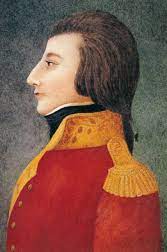
Too few are aware of how Ulster-Scots Protestants, Presbyterians and Church of Ireland alike, arrived in Ireland just a few generations, (such as Samuel Neilson editor of the Northern Star newspaper, pictured above), played a commanding role in helping shape early democracy on the island as well as contributing to Gaelic culture.
This ignorance is often the object of sectarian jibes and derision.
BRITISH
Ordinary people are reticent about British too, obviously the object of re-conquest nationalist iconoclasm.
The ‘I’m not British’ protestants often seem more prominent than their actual numbers in the public debate.
Sure, all the regalia comes out at the Twelfth and parades, with Remembrance Sunday or the Queen’s anniversaries also well marked.

But the reality is that, perhaps because of the perception of cross community tension created, all but the zealots seem to keep it to themselves the rest of the time.
Much has been talked about Irish freedom, McGuinness, Plunkett, Pearse and Tone.
But what is Irish freedom without the role of Irishmen who fought in the British army in the great struggle against European Fascism in WW2?
Instead of being included in a sense of shared Irish identity, this has no real place, brought out for a symbolic occasion, if at all, a footnote at best, British being purposefully foreign to most in Ireland.
Stick a permanent artefact of Britishness up in a non-unionist majority area and see how long it lasts before it falls victim to vandalism.
The language of peace, understanding and iconoclasm seem easily reconciled in all too many, in the rapidly forming new Ireland.
In many areas funders seem to prefer or sometimes insist on non contentious (read banal) public art.
ULSTER-SCOTS
Probe Ulster-Scots collective identity too much, or outside of safe social media groups (read ghettos) and it’s the same.
This complex weave of 400 years of narratives of a people with Irish and British national affiliations, both unionist and nationalist, is often reduced to being the object of negation and derision, the premises of collective existence commonly trashed by nationalist and (so called) liberal sectarian squabblers.
New Decade New Approach, when implemented will see the UK designate the Ulster-Scots community as a National Minority, under the Framework Convention for the Protection of National Minorities.
However, despite the Northern Ireland Human Rights Commission being supportive, the idea of a protestant community asserting a collective or ethnic/religious based minority status on the island, via the obvious Ulster-Scots route, is not well tolerated.
RECONCILIATION
In my opinion, a step away from this reticence would be greatly facilitated, if the protestant community developed a more rounded view of itself, especially as long dormant protestant nationalism is beginning to reemerge.
This will be hard for unionists, but an Irish societal conceding of some form of collective status to an Ulster protestant based secular community, via the Ulster-Scots, (or one of the other relevant collective terms) route, you would think, would be a no brainer with the united Ireland on the horizon.
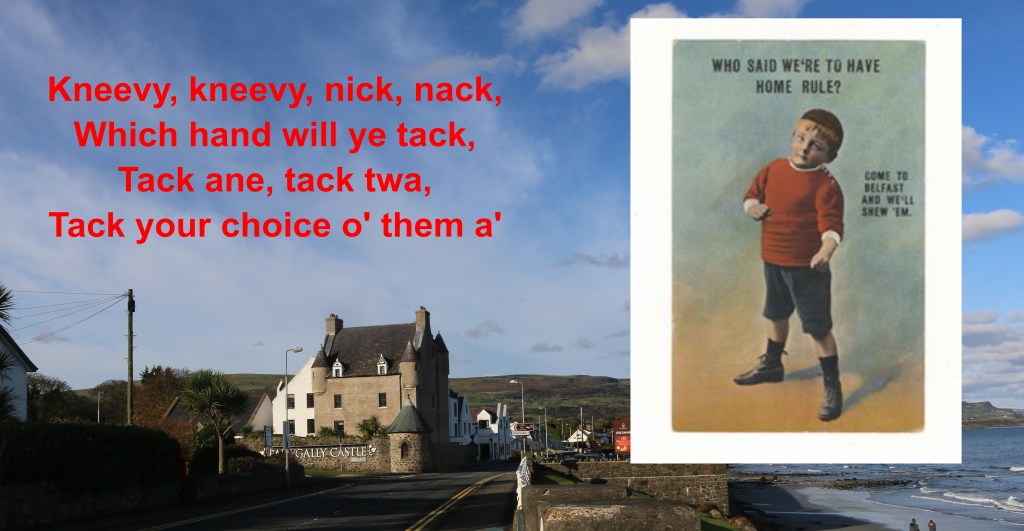
Quite a while back I discovered a child’s rhyme published by Belfast’s United Irishman newspaper The Northern Star in 1796.
Not uncommonly for the Northern Star it is written in Ulster-Scots and reads as follows.
Kneevy, kneevy, nick, nack,
Which hand will ye tack
Tack ane, tack twa,
Tack your choice o’ them a’.
Kneeve (usually nieve) is the Ulster-Scots for clenched fist and in the game you must pick which fist you think a coin is hidden in.
For me, the sarcastic fighting tone of the Northern Star piece, transformed the child’s game into two raised fists, almost as if to say ‘pick the one I’m going to hit you with first’.
This reminded me of an anti Home Rule postcard of a wee boy with his fists raised.
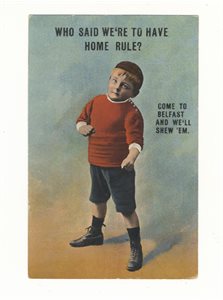
“Who said we’re to have Home Rule? Come to Belfast and we’ll show ‘em.”
Putting the two together, each a century apart, reconciling the apparently irreconcilable – just a thought.
Perhaps something to build on.
 Opinions creatively
Leave a comment